
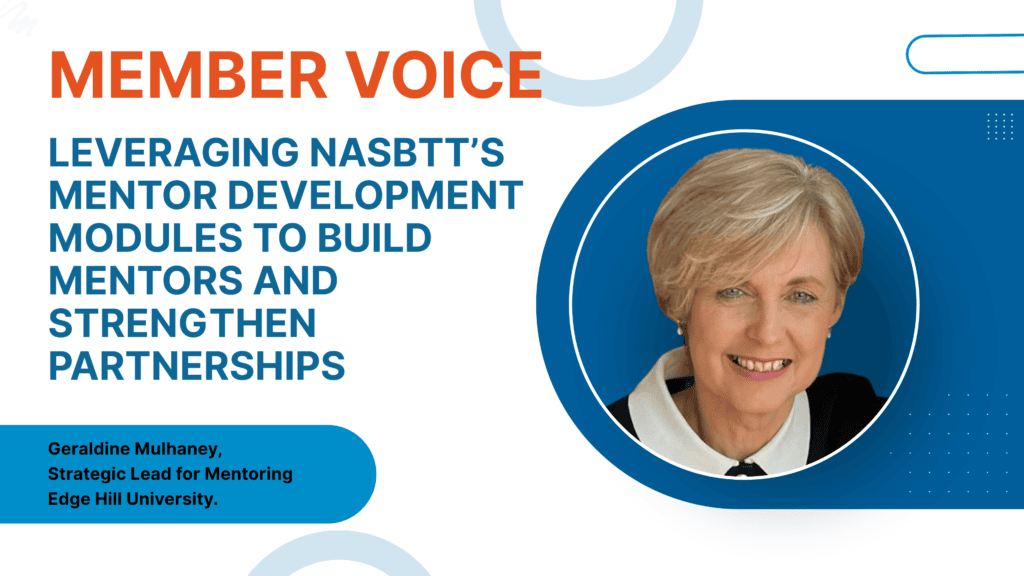
Geraldine Mulhaney is Strategic Lead for Mentoring at Edge Hill University. Here we speak to Geraldine about the University’s use of NASBTT’s Mentor Development Modules (MDMs).
Why, and when, did Edge Hill adopt MDMs?
“We began using the MDMs in 2024-25 to support partnership lead mentors, as part of our accreditation strategy, which had been approved with the DfE associate. For me, having been involved in mentoring at the University for the last couple of years, these modules have been an essential component supporting our lead mentor development. When it came to our partnership lead mentors, many of whom are based in partner schools and seconded to us one day a week, we needed a programme that could cater to a wide range of professionals with a real range and wealth of expertise and experience. The MDMs allowed us to combine a set programme of essential units with bespoke elements tailored to each individual, based on a diagnostic assessment. This approach ensures that our partnership lead mentors receive the best possible professional development during their time with us. For our general EHU mentors we wanted to create something that was distinctly ‘Edge Hill’ – materials written by our own tutors and course leaders, reflecting our mentoring principles, approach and values. Developing these modules took considerable time and effort as we came together to facilitate a collaborative approach between accredited providers of Initial Teacher Training (including HEIs and SCITTs) and Teaching Schools within the Liverpool City and Greater Merseyside region. As part of the process, the group identified and agreed the key components of the mentoring curriculum that all participating organisations would include and recognise, working in collaboration to support the schools in our region.”
How have you been utilising the Mentor Development Modules, and what aspects have particularly resonated with yourself and mentors?
“We have been actively using the MDMs by tailoring them to the needs of the partnership lead mentors that we work with. One of the aspects I have found particularly valuable is the flexibility of the modules – they cater to different stages of development, from classroom teachers to headteachers, allowing each lead mentor to engage with content that is most relevant to their current experience and context. For example, some lead mentors benefit from the foundational units for certain aspects, while others are ready to focus on embedding and sustaining practices. This approach really respects the diversity of our lead mentor cohort, given that we work across a wide geographical area and with schools at different stages of development. Certain modules have resonated strongly with our strategic development and the lead mentors. The sessions on navigating research and understanding the ITTECF framework have been especially impactful, as they give lead mentors the confidence to interpret and discuss research evidence with trainees and mentors. Similarly, modules focused on expert coaching, effective mentoring practice, and metacognition have provided practical strategies that mentors can immediately apply in their lead mentor roles.”
You are now in your second year of the MDMs. How have things evolved?
“This year, we have four main non-negotiable modules we are using for our partnership lead mentors with optional MDMs depending on the individual. We have incorporated content on SEND, trauma-informed practice, and DEI, which has helped establish a shared language and understanding across our partnership lead mentors, and this is essential for fostering confident, consistent support for trainees and mentors. I have also found that the combination of module engagement, reflective activities, peer discussion days, and one-to-one sessions really enhances the impact of the learning. Lead mentors not only complete the modules but also have structured opportunities to consolidate their understanding, share insights, and reflect on how they can apply these strategies in their own practice. Overall, the MDMs continue to be an integral part of our partnership lead mentor training.”
So, despite the changes in mentor training requirements, you have carried out with your plan for mentor development as it is best practice?
“Yes, absolutely. To be honest, with our lead mentoring in particular, we felt a real duty of care toward our lead mentors. They are such an important part of our partnership – they support our trainees and mentors in so many ways – and we wanted to make sure that any development we offered was genuinely valuable to them. Even though the training requirements and hours have changed slightly, we decided to carry on with our strategic plan for lead mentor development regardless. For us, it was about ensuring they felt confident, had followed best-practice processes, and ultimately that they could continue to provide highly effective mentoring. This year, we made the conscious decision to continue in that same vein, because supporting our lead mentors directly benefits our trainees, mentors and strengthens our partnerships.”
What have been the primary impacts of the MDMs, at this stage, on your mentors?
“The main impact is the increased confidence and clarity they have given our partnership lead mentors. Engaging with the modules has helped them become far more familiar with the ITTECF and with the curriculum components that underpin their work, which has strengthened the quality and consistency of their practice. Another major impact has been the protected time the modules provide. Because the training takes place during their allocated day with us – not after school or squeezed in around other commitments – mentors really value having the space to think, reflect, and properly engage with the materials. That opportunity for genuine reflection has supported substantial personal and professional growth. I have seen mentors develop a clearer sense of their own perspectives and positions, which in turn has enhanced the way they work with colleagues. This increased confidence has had a clear knock-on effect. Lead mentors now feel better equipped to support other mentors and trainees in school and university. They are more capable of holding effective coaching conversations and feel more confident in managing difficult or developmental discussions in a constructive and positive way. Their understanding of the curriculum, paired with their sense of the wider national picture, has also improved the support they offer around ITaPs. Finally, the modules have significantly strengthened the quality assurance work they do with us. By deepening their understanding of the ITTECF expectations, they approach QA and feedback with far greater clarity. They know what best practice looks like, they can see the intended outcomes, and they can offer mentors and link tutors much more focused, purposeful feedback.”
On a day-to-day basis, how has NASBTT support you with the roll-out of the modules?
“NASBTT have guided us through how the system works, including using the dashboard, recording progress, and drawing down data, which made the administrative side of things much easier. Once everything was set up, the modules themselves are so intuitive and visually engaging that we have been able to run them independently with our partnership lead mentors. The units are varied and interactive, with videos and reflective activities that our mentors really enjoy, so we have not had to call on NASBTT for support with the content itself. That said, we still value our ongoing relationship with them – attending CPD sessions, contributing to discussions around mentoring, lead mentors, ITaPs and being part of the national network helps us stay connected and share best practice with other universities and school-based ITT providers. NASBTT’s support also reinforces national expectations, which is really useful for ensuring continued development or our mentoring strategy and provides networking opportunities. Overall, their guidance has been invaluable, particularly in the set-up phase, while still allowing us the flexibility to manage the modules independently day to day.”
How do you plan to develop your use the Mentor Development Modules over the next 12 months (and beyond if appropriate)?
“At this point, we plan to continue engaging with the MDMs as part of Edge Hill’s core lead mentoring offer, building on the positive feedback from our lead mentors. The modules are particularly valuable because they provide a PD opportunity on a national level, allowing for bespoke areas of development that directly support growth as a lead mentor, and we would like to embed these more into our professional development offer. Beyond that, I am particularly interested in exploring how these modules might align with emerging accreditation pathways for mentoring, as gaining formal recognition for mentoring skills is something that we hope to achieve in the longer term. By doing so, we aim to not only strengthen our own lead mentoring practice but also contribute to establishing accredited mentor development qualifications which benefit EHU partnership and the wider mentoring community.”
Would you recommend NASBTT’s suite of MDMs to other university ITE providers?
“Yes, I am an advocate. From my experience, they have been a real asset for our partnership lead mentors. The modules provide a level of structure, range, and quality that would be incredibly difficult for us to reproduce and refresh year on year, particularly given the time constraints we work under. I also value that the programme is not static; it evolves each year with new units and updated content, which keeps it relevant and responsive. For us, the modules have been most beneficial for lead mentors, and that is where we would continue to use them. While we might consider extending them to general mentors if the funding were available, at the moment we prefer to retain ownership of what our general mentors do. But for lead mentors, the modules are something we do not want to lose. Feedback from my colleagues has reinforced this. They have found the platform intuitive, appreciated the diagnostic element, and particularly valued the inclusion focus this year. They described the courses as informative, reflective, and manageable in terms of reading load. They also highlighted how the additional recommended courses supported personal development and offered genuinely transferable skills – useful in their teaching roles and in their responsibilities as mentors. So yes, I would recommend NASBTT’s MDMs. They support mentor development in ways that are meaningful, practical, and sustainable for institutions like ours, and they clearly make a positive difference to the people using them.”
Case study developed: January 2026