
North Lincolnshire SCITT has been established since 2013, having previously been a Graduate Teacher Provider for over ten years. We are a small SCITT (averaging 20 trainees per year) offering both Primary and Secondary training. What makes us unusual is that we sit within North Lincolnshire Council, which is our legal entity.
Right from its earliest designation as a SCITT, the programme has been fully integrated with the local authority’s approach to workforce development in education, helping ensure that teacher training meets the specific needs of schools and the wider community in the area.
And so, North Lincolnshire SCITT is part of the Standards and Effectiveness team, yet quite distinct from it.
We work with local maintained schools and academies across the county and draw on expertise from the local authority and expert colleagues in schools. It was from this position that we developed our SEND training provision.
Following the NASBTT ITT Insights Survey findings in November 2025, which commented that…
‘When asked what specific training teachers need to deal with more complex needs in their schools, contributors emphasised that trainees must develop a deep understanding of both diagnosed and undiagnosed needs, including neurodiversity, SEMH, trauma and child development, while knowing when to seek specialist support. High-quality adaptive teaching and subject-specific strategies remain central to inclusive practice, with hands-on experience in diverse classroom contexts essential for translating theory into effective application…. Sustained, evidence-informed CPD – rather than one-off training – is seen as vital, alongside access to expert mentors, trauma-informed approaches and specialist pathways within ITT and ECF programmes.’
…we worked with schools to ascertain what they needed from a recent trainee; what did they want their new ECTs to know?
Mindful of the EEF’s Effective Professional Development guidance report and the importance of sustained, evidence informed CPD we planned our training to proactively equip trainees for what lies ahead.
Training overview:
Term 1 focuses on positive relationships and behaviour management, we look specifically at understanding what causes behaviours, and we particularly explore the work of Paul Dix, Daniel Willingham and Bill Rogers.
September
- Week 1: Right from the start of the course we place SEND at the heart, a golden thread that weaves throughout the training.
The Lead Teacher for SEND from the local authority and part of the Standards and Effectiveness Team delivers a session for us entitled: ‘How to provide good quality teaching and implement the Graduated Approach in the mainstream classroom’. It addresses the ITTECF Standard 2.6 and Standards 5.1,5.2,5.3, 5.7, 5.8 and 5.9.
The session covers:
- SEND Legislation
- SEND Areas of Need and the Graduated Approach
- Good Quality Teaching for pupils with SEND
- EEF SEND in Mainstream/Rosenshine Principles
- Week 2: training on visual impairment, hearing impairment and physical disability offering an in-depth understanding of degrees of impairment and strategies to support pupils in a mainstream class. Trainees learn how to check hearing aids and use assistive technology. Training on cognitive development includes SEND.
- Week 3: SEND teaching principles; learning theories to inform SEND teaching and learning in a mainstream school, led by the Head of SEND for the local authority.
October
- Week 7: SEMH; understanding of mental health, trauma-informed practice delivered by Assistant Psychologists from North Lincolnshire Children’s Care Group Rotherham, Doncaster & South Humber NHS Foundation Trust.
- Week 8: SEND neurodiversity led by the local authority’s Behaviour team and ASET team leads.
During October the trainees have a two-day placement in an Alternative Provision for pupils with SEMH needs
Training from With Me in Mind, an NHS mental health support team with the remit of Transforming Mental Health for Children and Young People, built on the training from local authority officers and focused on mental health. It provides evidence-based interventions for children with mild to moderate mental health difficulties.
The sessions from With Me in Mind are strategically planned throughout the year to not only support the trainee’s understanding of mental health issues but also to support them in managing their own stress and anxieties. These sessions are confidential and away from the SCITT team.
November
- Week 10: Input from the local authority’s SEMH team on identifying needs and practical strategies, revisiting and building on training from the previous month, mindful of training not being a one-off event.
This incorporates NASBTT Learn modules on managing anxiety, understanding ADHD, understanding autism, understanding dyslexia, and managing learning anxiety.
In Term 2, the focus is specifically on adaptive teaching, subject knowledge and planning.
The ITaP is entitled ‘Foreseeing Failure and Adaptive Teaching’ using what has been learned, observed and explored in Term 1, into their planning with more independence in Term 2 for individual needs.
Trainees spend two days in a special school, either primary or secondary, and a full day in a post-16 special school. North Lincolnshire has a number of independent and maintained special schools and we want our trainees to gain an in-depth understanding of how these schools support pupils and how they can use what they have learned to support needs in mainstream.
Assistive technology is a focus for this term and experts from the special schools and local authority officers provide training in this area.
With Me in Mind continues to provide practical strategies to support pupils in mainstream as well as trainee mental health support.
NASBTT Learn is a valuable resource. Trainees complete modules such as supporting speech, language and communication needs.
As trainees’ understanding of adaptive teaching develops, local authority officers provide training which builds on prior learning. This asks trainees to reflect on what they know to support needs and explore how effective their strategies have been.
A former SCITT trainee and teacher in a local secondary school delivers training on using AI to support adaptive teaching. This is a fascinating session as he demonstrates how to use AI to plan for SEND needs.
Subject specific training throughout the programme also includes the golden thread of adaptive teaching.
There is no central training in Term 3. The training programme supports trainees to plan for needs and to be proactive in ‘translating theory into effective application’. Mentors and SENDCos take a lead in providing trainees with the skills required to adapt teaching to meet needs and to recognise areas of SEND, neurodivergence and trauma. Trainees take part in multiagency meetings where possible.
Additionally, mentors are trained in understanding and supporting neurodiversity in the workplace as we know more trainees are coming with diagnosed and undiagnosed need. This is an invaluable training session to develop understanding of how schools can support their neurodivergent staff.
We found the NASBTT SEND Toolkit extremely useful to not only guide the training, but in tutorials and discussions with mentors.
From September 2026 we are offering a Primary with SEND route, written in partnership with two special schools based in Scunthorpe.
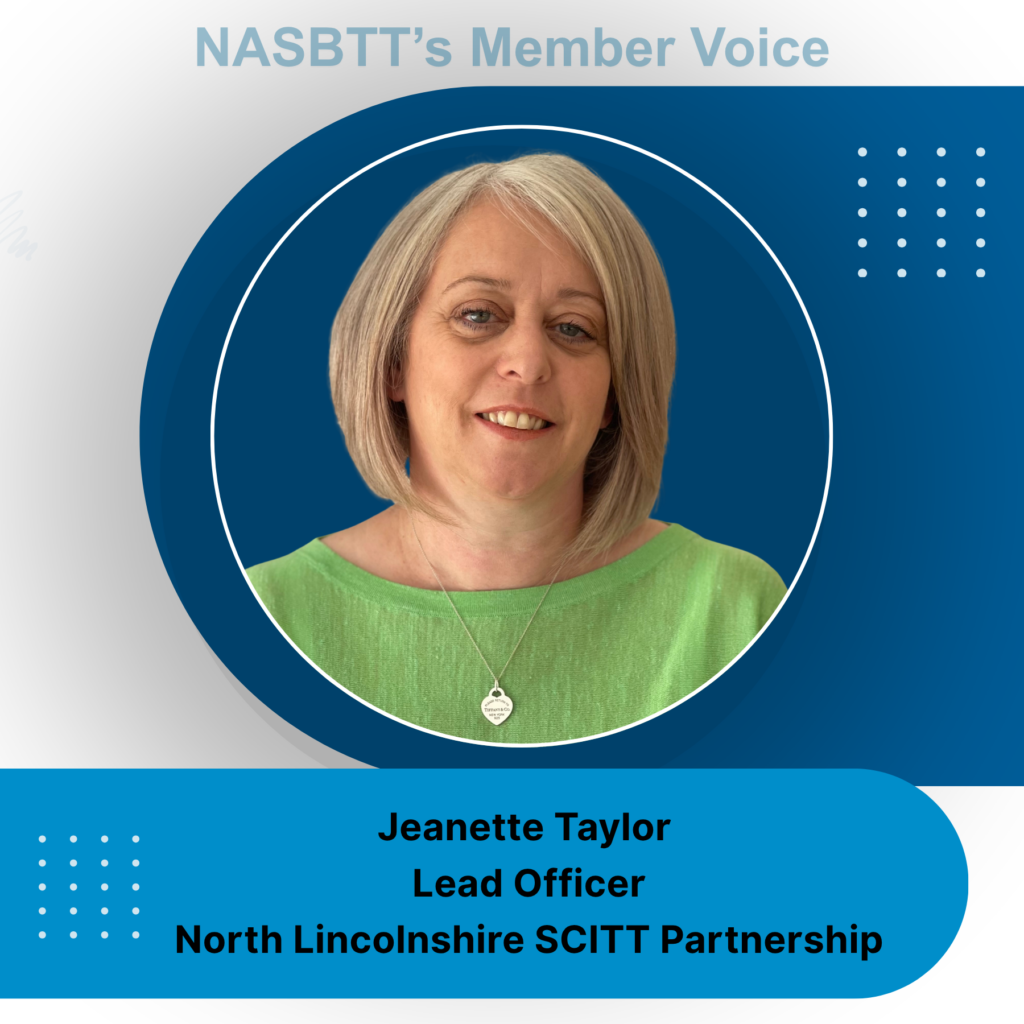
Jeanette Taylor is Lead Officer at North Lincolnshire SCITT Partnership.
Would you like to write for NASBTT? As part of NASBTT membership, ALL members have the opportunity to publish articles on our website for sharing through our community. We are seeking ideas for contributions from members around any aspect of ITT: insights on work you are undertaking, project successes you would like to share, or any viewpoint you would like to express. We are also keen to run ‘trainee voice’ blogs. If you have an article proposal, please email phil@philsmithcommunications.co.uk.