

Julia Mackintosh, Primary Geography Associate Consultant and member of the Geographical Association’s Teacher Education Phase Committee introduces a new set of resources designed to support primary teacher educators.
New resources to support primary teacher educators
For generalist primary teachers, who teach the full primary curriculum, having an in-depth knowledge of all subjects can be a challenge. To help meet this challenge, the Geographical Association’s Teacher Education Phase Committee (TEPC) have created a range of resources designed to provide specialist support for all who work with beginning teachers in the primary phase; this includes mentors, school-based trainers and ITE/ECT tutors.
Support for primary geography teacher educators
The resources, available via the GA website, include guidance on what makes a good primary geography mentor, advice on co-planning geography lessons and subject-specific feedback and prompt sheets to support subject-specific feedback for planning and lesson observations.
Details of the resources are outlined below.
What makes a good primary mentor?
In the webinar ‘What makes a good primary mentor?’, Anthony Barlow (University of Roehampton) discusses the attributes of a good mentor with Julia Mackintosh (University of Hertfordshire) and trainee teacher Ella. They discuss trainee teacher expectations, ideas about mentoring and the importance of adapting mentoring approaches over time as trainees develop confidence and expertise.
Co-planning lessons
In an ‘Introduction to co-planning’, Julia Mackintosh considers the collaborative development of lessons by mentors and beginning teachers. She outlines the benefits mentors ‘thinking aloud’ as they explore lesson content with their mentee, exposing the tacit and often ‘hidden’ knowledge that influences their lesson design. Making their decisions explicit as they plan a geography lesson with a beginning teacher, mentors can help to develop beginning teachers’ understanding of how, rather than just what, to plan.
Examples of co-planning conversations with trainee teachers Maisy and Scarlett are also provided in two short videos. These demonstrate how mentors can help trainees to focus on key learning, lesson design and sequencing and how all pupils might be supported to access geographical learning. Both are focused on Key Stage Two geography topics – one on the distribution of volcanoes and the other on river processes.
Subject specific prompts to support lesson planning and observation feedback
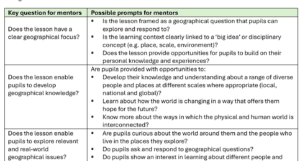
To further support mentors, trainers and tutors during geography lesson planning conversations, Vicki Pountney (Sheffield Hallam University) has created a set of key questions and prompts focusing on key geographical learning. These provide mentors with questions designed to encourage the development of lessons that support pupils to think and work like a geographer and to make use of geographical knowledge.
Prompts are also provided to support mentors when they observe lessons to ensure that feedback has a geographical focus. As shown in the extract below, the prompts encourage mentors to consider ideas such as whether the lesson observed is rooted in enquiry, addresses key geographical concepts and provides opportunities for pupils to make connections to their everyday lives as well as within and between geography topics.
Giving subject-specific feedback
In this webinar Anthony Barlow is joined again by Julia Mackintosh and Ella as they consider a Key Stage One lesson taught by Ella focusing on a distant locality – the Amazon Rainforest. They discuss how subject-specific guidance can support effective post-lesson feedback; they outline the benefits of focusing on a specific aspect of geographical learning, the importance of helping trainee teachers to make geographical connections and the use of pupils’ work to ensure that lesson feedback is focused on pupil learning. In the light of her recent experiences as a trainee teacher, Ella highlights the value of mentors sharing pupils’ prior geographical knowledge and experiences.
All of the resources to support primary teacher educators are free to download and the Geographical Association’s TEPC plan to add to the resource bank throughout the year.